Affordable Original Abstract Art Under $1,000 (2026): The No-Nonsense Buyer's Guide
- Kanan Alibayov
- Jul 16
- 13 min read
Here's the thing nobody tells you when you start looking for affordable original abstract art: the market is enormous, confusing, and full of things that look like original art but aren't.
Mass-produced prints sold as "original." Digitally generated images passed off as hand-created work. Print-on-demand reproductions with no artist behind them, no provenance, no story. They show up in every search for affordable abstract wall art, they look fine in product photos, and they feel hollow the moment they're on your wall.
The alternative isn't spending $10,000.
There's a real middle ground: original abstract art with genuine artistic process behind it, reproduced in formats that last, from artists who can tell you exactly what they made and how they made it, at prices well under $1,000. Most people just don't know where to look or what questions to ask.
This guide covers both. What affordable original abstract art actually means in 2026, what to look for and what to avoid, how the format affects quality and price, and where to buy abstract art online without gambling on whether what arrives matches what you ordered.
What "Affordable Abstract Art" Actually Means (and What It Doesn't)
Let's deal with the cheap abstract art problem directly.
When people search "cheap abstract art" or "inexpensive abstract wall art," they're usually looking for one of three things: a print-on-demand product from a mass retailer, a licensed reproduction of someone else's work, or software-generated content that nobody specifically created. All of these exist. None of them are original art. And none of them cost $1,000, which is part of why the confusion persists.
Affordable original art is a different category entirely.
Artsy's guide for first-time art buyers notes that prints from emerging artists are often "a good icebreaker" into collecting: genuine artistic value at accessible price points, without the intimidation of a gallery setting or a five-figure price tag. That's the zone this guide is aimed at. Work with a real artist behind it, a real process, and documentation that tells you what you're actually buying.
Under $1,000 for original abstract art gets you more than most people expect:
High-resolution reproductions of original ink-on-paper abstract works, produced at a fine art print studio with color-managed proofing and archival substrates
Limited edition abstract art prints, signed and numbered, with certificates of authenticity
Open edition abstract art prints in archival formats that will outlast the wall they're hanging on
Small-format original paintings from emerging artists at the early stages of their careers
What it doesn't get you: an original painting by an established artist with a decade of exhibition history. That market starts higher and climbs fast. But for someone who wants to buy original abstract art and get something with genuine value behind it, under $1,000 is a very workable budget.
Original Art vs Print: What the Difference Actually Costs You
An original painting is the physical object the artist made. One exists. Nobody else has one. The provenance is complete from the moment the artist's pen, brush, or tool touched the surface. An original abstract painting by an artist with any exhibition presence starts in the hundreds and climbs quickly.
An abstract art print is a high-quality reproduction of an original work, produced in multiples. The original still exists somewhere. What you're buying is access to the image and the artist's vision at a fraction of the cost, in a format that can be made to last decades.
The quality of that reproduction is where the gap opens.
Format | What It Is | Price Range | Archival Life | Best For |
Original painting | One-of-a-kind physical work | $500 to $5,000+ emerging artist | Indefinite with care | Collectors; maximum investment value |
Limited edition giclée print | Archival inkjet, fixed run, signed/numbered | $150 to $600 | 75 to 100+ years | First-time collectors; strong resale potential |
Open edition art print | Archival inkjet, unlimited run | $50 to $300 | 50 to 100 years with archival inks | Decorating; accessible price point |
Metal print (dye sublimation) | $100 to $500 | 60 to 75+ years | Durability; luminosity; humid rooms | |
Print-on-demand (mass market) | Digital image, no artist involvement | $15 to $150 | 10 to 30 years typically | Budget decorating only; zero collecting value |
The format distinction matters more in abstract art than in most categories. Abstract work depends on tonal relationships, edge quality, and the subtlety of mark-making. A poorly produced reproduction flattens all of that. A high-resolution reproduction on archival substrate with color-managed proofing preserves it. The price gap between those is real. The quality gap is larger.
How to Start Collecting Abstract Art Without Losing Your Mind
The traditional advice, visit galleries, build relationships, attend art fairs, is still good. It's also not practical for most people who just want to buy affordable abstract wall art for their living room.
Here's the shorter version.
Start with what you actually respond to. Not what photographs well. Not what's trending. What do you look at in a room and want to keep looking at? Abstract art rewards this approach specifically because there's no narrative to parse. It's either doing something for you or it isn't. Figure that out before worrying about price or provenance.
Understand what you're buying. Before you buy abstract art online from any source, ask: Is this a reproduction of an original work or a digitally generated image? What substrate? What inks? Is there a certificate of authenticity? Is the artist contactable? Good sources answer these questions without hesitation. If the listing doesn't include this information and the seller can't provide it, skip it.
Set a range, not just a ceiling. Most first-time buyers set a spending limit and end up buying something wrong for their space because they stayed under it at the expense of quality. "I want to spend between $200 and $600 on a piece I'll keep for ten years" is a more useful constraint than "I won't spend more than $300."
Size up, not down. The most common regret in abstract art buying isn't price. It's scale. A piece that looks substantial in a product photo often reads as tentative in an actual room. Measure the wall. Mark the dimensions with painter's tape. Then look at the tape and decide if you need to go larger. You probably do.
Get the documentation. Any reputable seller of original abstract art for sale should provide a certificate of authenticity with the artist's name, the title, the medium, the edition details if applicable, and the print studio if it's a reproduction. This isn't just formality. It's what establishes that the piece has a real artist behind it.
What to Check Before You Buy Abstract Art Online
The online art market has made buying abstract art genuinely accessible. It's also made it easier to accidentally buy something that looks like art and isn't.
The source of the image. Is this a reproduction of an original work by a specific artist, or a stock image printed on demand? This should be stated clearly in the listing. If it isn't, ask. If the seller can't answer, move on.
Resolution and substrate. For a 24 by 36 inch abstract art print, the source image should be at minimum 150 DPI at final output size. Lower than that, grain shows up at normal viewing distance. The substrate should be specified: archival paper, cotton rag, or aluminum for metal prints. "High quality materials" without specifics is not an answer.
Edition details. A hand signed art print in a limited edition of 50 is a meaningfully different object from an unlimited open edition. Neither is wrong to buy. You should know which one you're getting. The edition details should be on the certificate of authenticity and ideally penciled below the image on the print itself.
Return policy. Reputable online art galleries offer returns within a reasonable window. Some offer proof prints before the final piece is produced. At minimum, the seller should be willing to discuss concerns before you commit.
The artist. There should be one. A name, a website, a body of work you can look at. The absence of any artist identity is a strong signal that what you're looking at is a product, not art.
Abstract Art as Investment vs Abstract Art as Something You Love
Most serious collectors have strong opinions about this distinction. Here's the honest take.
Abstract art under $1,000 is unlikely to generate significant financial returns in any predictable timeframe. The exception is limited edition art prints from artists who go on to build substantial exhibition careers; those can appreciate meaningfully. But treating a $400 abstract art print as a financial investment is probably the wrong frame.
The right frame: you're acquiring something you want to live with, from an artist whose work you want to support, in a format that lasts long enough to be worth keeping.
Does abstract art hold value financially? Sometimes, with limited editions from artists who build serious careers. More often, the value is experiential rather than monetary. Buy accordingly.
Consideration | Original Painting | Limited Edition Print | Open Edition Print |
Financial investment potential | Highest (unique work) | Moderate (scarcity drives value) | Low (unlimited supply) |
Artistic value | Highest | High | High (if well-produced) |
Price range under $1,000 | Small format, emerging artist only | Most mid-range options | Widest range of options |
Documentation | Provenance from artist | Certificate, edition number | Certificate |
Resale market | Active for established artists | Growing for limited editions | Very limited |
Best reason to buy | You want the original object | You want documented scarcity | You want the image at accessible cost |
Where to Buy Affordable Abstract Art Online in 2026
The market has fragmented. Here's an honest picture of the main options.
Artist-direct. Buying abstract art directly from the artist is the best option when available. Best value, best provenance, best story. Most working artists have websites, and many reproduce their work in archival formats at accessible prices. The limitation is discovery: finding an artist whose work you love takes more time than browsing a curated platform.
Curated online galleries. Platforms like Saatchi Art, Zatista, and UGallery vet artists and offer returns, which makes them lower-risk than buying from an unknown seller. The trade-off is platform margin: prices are typically higher than buying artist-direct. For first-time buyers who want more protection and less research, a reasonable starting point.
Etsy abstract art. Etsy hosts a wide range of affordable abstract art, from genuine artist reproductions to mass print-on-demand products. The quality gap is enormous. Read each listing carefully. Look for artists with verifiable bodies of work and clear statements about what they're selling. "Digital download" listings produce something you print yourself and have no archival value whatsoever.
Independent artist websites. Often the best value in the entire category. Artists who reproduce their own work professionally, manage their documentation, and ship directly can offer the quality of a curated gallery at closer to artist-direct pricing. Most of the genuine value in the under $1,000 abstract art market lives here.
What to avoid. Any listing that uses "original" loosely, doesn't name an artist, can't tell you what substrate the print is on, or offers unlimited reproductions without edition documentation. These signals don't always indicate fraud, but they consistently indicate something that won't hold its value or your interest.
Why Format Matters More Than Most People Think
There are several ways to produce an affordable abstract art print and they are not equivalent.
Giclée prints use professional archival inkjet printers with 8 to 12 color channels and pigment-based inks. On cotton rag or archival paper, a properly produced giclée maintains color fidelity for 75 to 100 years. This is the standard format most fine art galleries use for their print editions.
Metal prints use dye sublimation to bond the image into a specially coated aluminum substrate. The image doesn't sit on top of the surface; it becomes part of it. This makes metal prints physically more durable than any paper option: moisture-resistant, scratch-resistant, immune to the warping that affects canvas over time. The luminosity of the aluminum substrate gives metal prints a visual quality that paper doesn't replicate, particularly in abstract work with strong tonal contrast. They also don't need glass, don't need frames, and arrive ready to hang.
Canvas prints are familiar but carry specific limitations for abstract art. The fabric weave introduces texture that can interfere with fine tonal detail. Canvas stretched over wooden frames responds to humidity over time, causing bowing or loosening. For abstract work with strong gestural marks and tonal depth, the substrate texture works against the image rather than with it.
For most abstract art buyers under $1,000, the real choice is giclée on archival paper or metal. Variable light, moisture concerns, or a format that needs zero maintenance for decades: metal. Warmth and a surface that reads as a print rather than a panel: archival paper giclée.
How We Price Our Work at Mosaics by Marc
Being direct about this because people searching for affordable abstract art deserve straight answers.
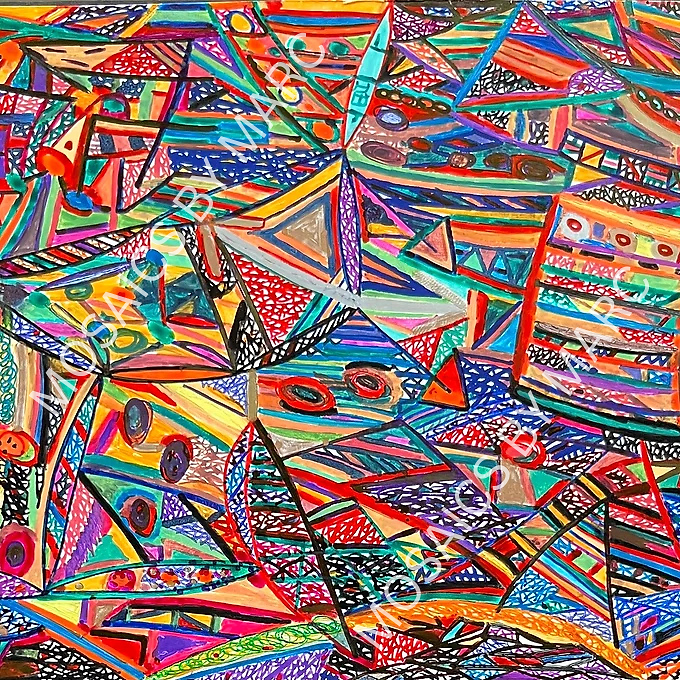
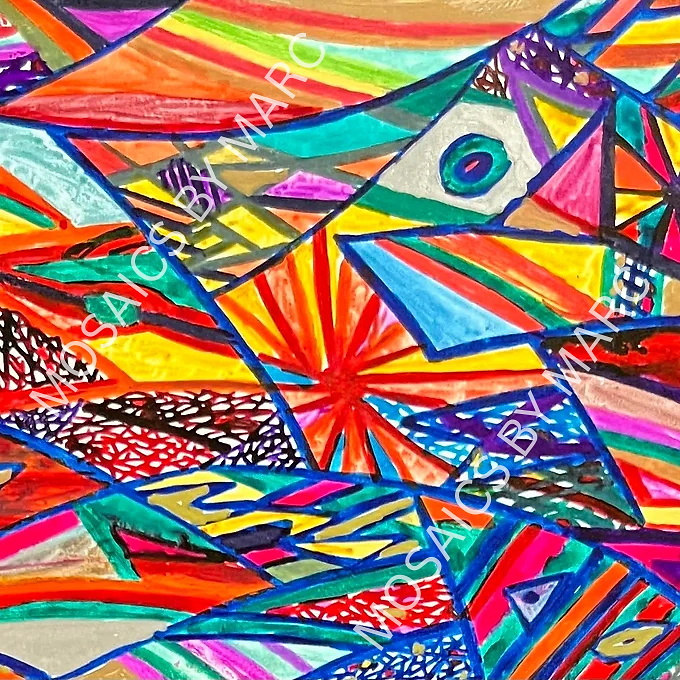
Marc works in ink on paper. His process is non-preconceived: no sketches, no planned composition, no predetermined color direction. Each piece builds through layers of ink applied across multiple sessions, using fountain pens, ballpoint pens, rollerball gel pens, paint pens, and fine markers on card stock and drawing paper. The originals are physical objects with 35 years of creative and professional practice behind them.
We reproduce those originals as metal prints. Not because metal is fashionable, but because it's what the work requires. Ink-based abstract art has tonal depth and edge detail that the dye sublimation process preserves on aluminum in a way that paper tends to soften. The luminosity of the substrate keeps darker passages from going flat and lighter passages from washing out.
Every piece starts with a professional high-resolution scan, goes through color-managed proofing, and ships with UV-resistant coating and a float mount. Fully documented. No print-on-demand. Every piece is produced from Marc's original source scan, in a format we stand behind.
Under $500 gets you a smaller format piece at the same production standard as our largest prints. Under $1,000 opens up mid-range and larger sizes where the tonal depth of the work really opens up.
Check out our shop page or Reach out to us directly with your wall dimensions, room context, and budget. We'll tell you which piece works and which size makes sense. No pressure, straight answers.


Frequently Asked Questions
Q: What is affordable original abstract art?
Affordable original abstract art refers to work with a genuine artist and creative process behind it, available in formats accessible on a real-world budget. Under $1,000 covers a wide range: limited edition giclée prints and metal prints reproduced from original works, signed and documented, from artists with verifiable bodies of work. It doesn't include mass-produced prints with no artist behind them, digitally generated images sold as art, or print-on-demand products without provenance documentation.
Q: Where can I buy affordable abstract art online?
The best sources for affordable abstract art online are artist-direct websites (best value and provenance), curated online art galleries like Saatchi Art and Zatista (more buyer protection, higher prices), and specialist independent artists who reproduce their work professionally and ship directly. On Etsy, read each listing carefully since the quality gap between genuine artist reproductions and mass print-on-demand is enormous.
Q: What is the difference between an original abstract painting and an abstract art print?
An original abstract painting is the physical object the artist created, unique and unrepeatable. An abstract art print is a high-quality reproduction of an original work, produced in multiples. The value of a print comes from the quality of the reproduction, the archival integrity of the substrate and inks, the documentation, and the edition size. A well-produced limited edition abstract art print from a serious artist is a genuinely collectible object. A mass-produced reproduction of a stock image is not.
Q: Is abstract art a good investment under $1,000?
Financially, under $1,000 abstract art is unlikely to generate significant returns in a predictable timeframe. Limited edition prints from artists who go on to build serious exhibition careers can appreciate meaningfully. The better frame is whether the piece has genuine artistic value, whether you'll want to live with it long-term, and whether the format will hold up. A well-made metal print or archival giclée of an original abstract work is a good investment in the sense that it will still be worth owning in 30 years.
Q: What should I look for when buying original abstract art for sale online?
Before buying: verify there's a specific named artist behind the work; confirm the substrate; check that inks are archival pigment-based; ask for edition details and a certificate of authenticity; confirm the return policy. Red flags include listings with no artist name, "high quality materials" without specifics, no documentation, and no contact information for the artist or studio.
Q: What is the best format for affordable abstract wall art?
For most buyers under $1,000, the choice is between giclée on archival paper and metal prints. Metal prints are more physically durable, moisture-resistant, and tend to preserve tonal depth in abstract work with strong contrast. Archival giclée on cotton rag gives a warmer surface quality and suits abstract work with more muted palettes. Both can last 60 to 100 years under normal indoor conditions. Canvas prints in the same price range are generally a step below in longevity and tonal fidelity.
Q: What does limited edition abstract art print mean?
A limited edition abstract art print is a reproduction produced in a defined, fixed quantity. The artist or publisher commits to a specific number, say 50 or 100, and once that run is complete, no more prints of that image are made. Each print is typically hand signed by the artist and numbered (for example, 12/50). A numbered art print carries stronger collectible value than an open edition because the scarcity is defined and documented.
Q: What is a certificate of authenticity for art and why does it matter?
A certificate of authenticity records the specific details of a piece: the artist's name, title, medium, edition size and number, print studio, substrate and inks, and date of production. It establishes that the piece has a verifiable origin and is what the seller says it is. For any piece of original abstract art for sale, a certificate of authenticity is not optional. If a seller can't provide one, the provenance is unverifiable.
Q: How do I know if abstract art online is genuine?
Look for a verifiable artist with a named website or exhibition history. Ask what the source of the image is: was it scanned from an original physical work or generated digitally? Ask for substrate, ink, and edition details. Ask whether a certificate of authenticity is included. Any seller of genuine original abstract art for sale should answer these questions without hesitation.
Q: What is the difference between affordable abstract art and cheap abstract art?
Affordable abstract art has a real artist, a real process, archival materials, and provenance documentation. It's accessible because the artist has made intentional choices about format and edition structure, not because quality has been sacrificed. Cheap abstract art, in the sense the term usually implies, has no artist behind it, uses non-archival materials, and is designed to fill wall space rather than to be collected or kept. You can spend $50 on either category. Only one of them is worth keeping.
Q: Can I buy affordable abstract art as a gift?
Yes, and it's one of the better gift categories for people who care about their homes. A well-documented limited edition abstract art print, with a certificate of authenticity and a clear story about the artist and their process, is a meaningfully different gift from a mass-market print. For gifting, focus on smaller formats (easier to ship and hang), documented editions, and sellers who can provide gift-ready packaging and documentation.
Final Thoughts
The affordable original abstract art market is better than most people think and more confusing than it needs to be. The quality is real. The provenance question is solvable. The formats available under $1,000 in 2026 are genuinely archival.
What trips people up is the noise: listings that look like art but aren't, "original" labels on mass-produced prints, size trap purchases that read wrong on the wall.
Most of that is avoidable with the right questions asked before you order. Named artist. Real substrate. Actual dimensions measured on your actual wall. Certificate of authenticity.
Return policy. Not complicated. Just the minimum for buying something worth keeping.
If you're looking at Marc's work and want to know how a specific piece would be produced, what size suits your wall, and what the documentation looks like, reach out to us. Straight answers before every sale.
Prices in this article reflect general market ranges for affordable abstract art as of July 2026. Artist-direct and gallery pricing varies based on edition size, substrate, format, and artist. Always request full documentation before completing any purchase.


Comments